



Railroad Tie Wall Replacement in New Orleans: Rebuild the Beds That Are Failing
New Orleans sits flat between the Mississippi River and Lake Pontchartrain, much of it below sea level, and the soil under most yards is soft organic clay and peat with a water table a few feet down. If your property has a railroad tie wall replacement in New Orleans need, you are likely looking at a bed edge or low retaining wall built in the 1970s or 80s, back when creosote ties were the cheap, fast way to hold a slope or a planting bed. Those ties are now rotting, leaning, and pushing out of line from Mid-City to Lakeview, and the Formosan termites in this city treat old timber as food.
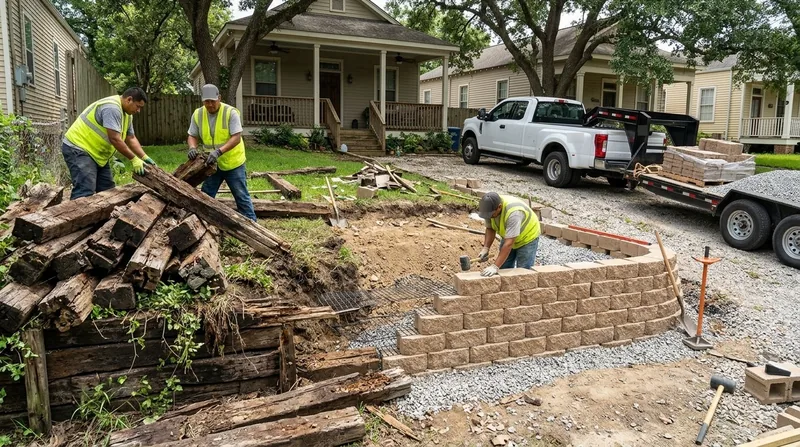
We remove the old ties, haul the creosote-treated material away, rebuild the gravel backfill and drainage, and set a new wall in segmental block, poured concrete, or natural stone. If your wall is leaning or has already collapsed, start with leaning and collapsed wall repair before it takes a driveway or a slab with it.
Why Old Railroad Tie Walls Fail in New Orleans Soil
Creosote-treated ties were never meant to last fifty years in ground this wet. The organic clay and peat under New Orleans yards shift with every wet season, the water table sits close to the surface, and the ties soak up moisture until they soften and rot from the inside. Add Formosan termites, which are active across the metro, and a tie wall that looked solid in 1995 is often hollow by 2024.
- Ties rot and lose their structural strength, so the wall starts to lean or bulge outward.
- Termites tunnel through the timber and leave voids you cannot see from the top.
- Original backfill was usually dirt, not gravel, so water pressure builds up behind the wall.
- Hurricane and summer cloudburst rain saturates the soil and pushes failing walls over.
- Creosote leaches into beds and can damage plants and stain nearby concrete.
Once a tie wall starts to move, patching it rarely holds, and a full replacement is the cheaper path over the next ten years.
Key info: In Gentilly and New Orleans East, we routinely pull tie walls that were set directly on muck with no gravel base. Those walls settle unevenly within a few years, which is why we always excavate to stable soil and rebuild the base before setting new material.
For the permit side, thresholds vary by jurisdiction, so confirm with the local building department before you start. A wall above roughly 4 feet from the footing, or one that supports a driveway or structure, often needs a permit and sometimes engineered drawings. The City of New Orleans permitting information is the place to verify: New Orleans One Stop Shop.
How We Replace a Railroad Tie Wall in New Orleans
Every replacement starts with a site walk and a look at what is behind the wall. We check the slope, the drainage path, the proximity of the house or slab, and whether the old ties are holding back a bed edge or a real grade change. Then we sequence the work so the yard is not torn up longer than it needs to be.
- We mark utilities and confirm the wall line and height with you before any digging.
- We cut and pull the old ties, then haul the creosote-treated material to an approved disposal site.
- We excavate to stable soil and shape a proper base, because New Orleans clay and peat will not carry a wall on their own.
- We install compacted gravel backfill and a drainage path so water moves away from the wall instead of pushing on it.
- We set the new wall in segmental block, poured concrete, or natural stone, depending on the look and the load.
- We backfill, compact in lifts, and clean the site so the beds and lawn are ready to use.
Most low bed edges in Bywater and the Marigny are a one to two day job, while taller walls that hold a raised slab in Lakeview take longer.
Key info: On a recent job in Harahan, the old tie wall was holding a driveway ramp that had settled about 3 inches. We replaced it with a segmental block wall and a gravel drainage chimney, and the ramp stopped moving within the first rainy week.
If the wall is part of a bigger grade problem, pair the replacement with retaining wall drainage so the new wall is not fighting the same water the old one lost to.
Replacement Approaches We Use in New Orleans
The right material depends on height, load, and how the wall looks against the house. A low bed edge in Uptown does not need the same wall as a driveway ramp in Metairie, and we will tell you which one fits your site.
| Approach | Description | Best for |
|---|---|---|
| Segmental block replacement | Old ties out, gravel base and drainage in, new interlocking block wall set in courses. | Bed edges and low walls up to about 4 feet, common in Mid-City and Gentilly. |
| Poured concrete replacement | Formed and poured wall with rebar, keyed into a stable base, with drainage behind. | Driveway ramps and walls that carry a surcharge, such as in Lakeview. |
| Natural stone replacement | Boulder or stacked stone wall set on gravel, sized to the grade change. | Garden District and Uptown yards where the look matters as much as the hold. |
| Timber replacement (new treated timber) | Modern pressure-treated timber set on gravel with a drainage path, not creosote ties. | Low, short bed edges where budget is the priority. |
| Remove and regrade only | Ties out, grade reshaped and stabilized without a structural wall. | Shallow bed edges that never needed a wall in the first place. |
We will recommend the approach that matches the load and the look, not the one that is easiest to sell.
Railroad Tie Wall Replacement Cost in New Orleans: What to Expect
Most railroad tie wall replacements in New Orleans start around From $35/sq ft, and the final number depends on wall height, length, access, and what we find once the old ties come out. A low bed edge in a Marigny backyard is a different job from a wall holding a raised slab in Lakeview, and the price reflects that.
Access is the biggest swing factor. A wall you can reach with a wheelbarrow and a compact machine is cheaper than one behind a narrow shotgun side yard or across a finished patio. Wall height and the load behind it matter too, because a taller wall needs a deeper base and more backfill. If the old ties are sitting on muck, we may need to excavate deeper, which adds time.
Getting two or three estimates is smart, and not just on price. Ask each contractor how they handle drainage, what they do with the creosote ties, and whether the base is included. A low bid that skips the gravel backfill will cost you again in five years. Our full pricing overview breaks down what drives the number.
What to Look for When Hiring a Retaining Wall Contractor Near New Orleans
Hiring for a railroad tie wall replacement near me in New Orleans comes down to a few basics. Confirm the contractor is fully insured, ask for the certificate, and check that the insurance covers both general liability and workers comp. Get at least two or three written estimates that spell out the base, the drainage, and the disposal of the old ties.
Ask for references from jobs in your part of the metro, and call them. A contractor who works in Gentilly and New Orleans East will know how the soil behaves there, and one who works in the Garden District will know what the neighborhood expects to see. Ask who pulls the permit if one is required, and confirm the wall height and setback rules with the local building department before work starts.
If your property is in a historic district or under HOA rules, check the requirements before you pick a material. Ready to get a number? Contact us for a free estimate and we will walk the site with you.
Railroad Tie Wall Replacement in New Orleans: Pricing Guide
| Service | Price | Details |
|---|---|---|
| Low bed edge replacement (under 2 ft) | Starting at $35/sq ft | Includes tie removal, gravel base, new block or timber, and haul-away of old creosote ties. |
| Mid-height wall replacement (2 to 4 ft) | Starting at $55/sq ft | Adds deeper excavation, compacted backfill lifts, and a drainage path behind the new wall. |
| Wall carrying a surcharge (driveway or slab) | On estimate | Load-bearing walls need an on-site look at the base, the load, and any permit or engineering requirement. |
| Difficult access (narrow side yard, finished patio) | Quoted per job | Hand-carry of material and protection of finished surfaces add labor, priced after the site walk. |
| Travel | Included | In New Orleans and surrounding areas, no separate call-out or mileage fee. |
| Estimate | Free | Response within 24h at (504) 399-7980, no obligation to book. |
Indicative pricing, the exact cost depends on square footage, finish, and site access. Free personalized estimate within 24h at (504) 399-7980.


